| Siegling transilon | Thickness [mm] | Weight [kg/m²] |
| NOVO 25 HC black (900195) | 2.7 | 1.45 |
| E 3/2 U0/U2 NA white FDA (900085) | 1.5 | 1.6 |
| E 8/2 U0/U2 green FDA (900320) | 1.4 | 1.6 |
| E 3/1 U0/U0 transparent FDA (906430) | 0.85 | 0.6 |
| E 4/1 U0/V5H MT green (900171) | 1.1 | 1.25 |
| E 8/2 V1/V1 blue (996060) | 2.0 | 2.55 |
| E 8/2 0/V5H S/MT black (996141) | 2.1 | 2.4 |
| E 8/2 U0/V5 MT white FDA (900028) | 2.2 | 2.5 |
| E 8/2 U0/V5 NP white FDA (900029) | 2.1 | 2.15 |
| E 8/2 U0/V7 SG black (906286) | 2.3 | 2.45 |
| E 8/2 U0/V15 LG-SE black (906313) | 3.1 | 3.4 |
| E 15/M V1/V10 MT white FDA (900093) | 5.0 | 5.3 |
Under the Siegling Transilon brand name, Forbo Siegling has developed a product line of 600 different designs worldwide that consistently reflects market require ments. Forbo Siegling has the best belt type for various goods, conveying speeds, reversing systems, stop & go and accumulation conveying, and other operating conditions. Some examples of the diverse features of Siegling Transilon include:
- troughable to particularly laterally stiff types
- exceptionally low-noise to flame-retardant
- pyrolysis-resistant to suitability for conveying unpackaged food
- non-antistatic to highly conductive and ATEX-approved
- surfaces suitable for accumulation conveying and especially good grip.
Inclined conveying
Goods can be conveyed at an incline even on smooth belt surfaces. The conveying angle is dependent on a variety of factors such as the type of goods being conveyed, the top face coating and external factors like dust, moisture, etc. For large conveying angles and for the conveying of small pieces and bulk goods, Forbo Siegling offers patterned belts or belts equipped with lateral profiles.
Curved conveying
Curved belts from Forbo Siegling are suitable for use in conjunction with a diverse array of belt tracking systems and are in use on the conveyors of numerous major manu facturers. Thanks to largely-automated fabrication, we guarantee strict adherence to the geometrical shapes and dimensions required when supplying finished belts. Dividing curves into several segments makes for a favourable distribution of force vectors in the belt so even heavy goods can be carried without any problems.
Collection and distribution
When pushers and ploughs are used, the belt’s laterally stiff design guarantees that it will lie flat and continue to run in a straight line reliably. The lateral loading and discharge of goods is achieved by using very smooth, wear-resistant surfaces. Lateral sorters (e.g. carrier cells), on the other hand, require very thin, flexible belts whose surfaces have high coefficients of friction. Their special tension member construction means that they have very low energy consumption.
Processing belts
With Siegling Transilon, the gap is often bridged between the classical conveying function from “A” to “B” and an active function in the production process. For example, in the textile industry our processing belts stack thin layers of web, in large bakeries they form balls of dough, in the wood industry they compress chip mat in the pre-press, in dairies milk is coagulated on the belts to form cheese.
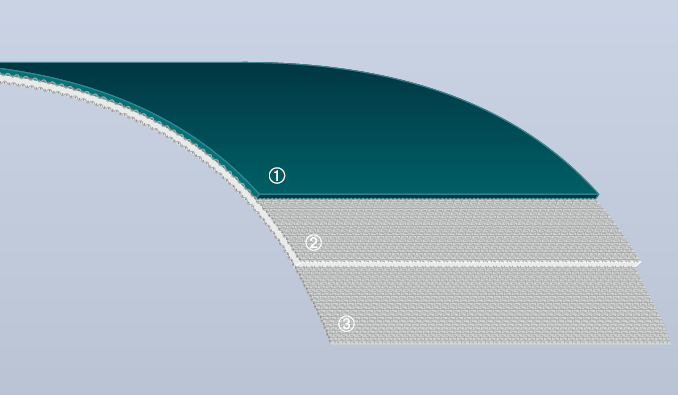
PRODUCT STRUCTURE

①Top face
Various coating materials, thicknesses and patterns determine grip, chemical, physiological and mechanical properties of the belt.
②Tension member
The use of various special fabrics largely determines the suitability for specific applications. Belt tracking properties, load/elongation properties, electrostatic properties, flatness, knife edge and curve suitability are directly dependant on the fabric construction.
③Underside
The design of the underside determines the noise emission, wear, and suitability for sliding-or rolling support of the belt.
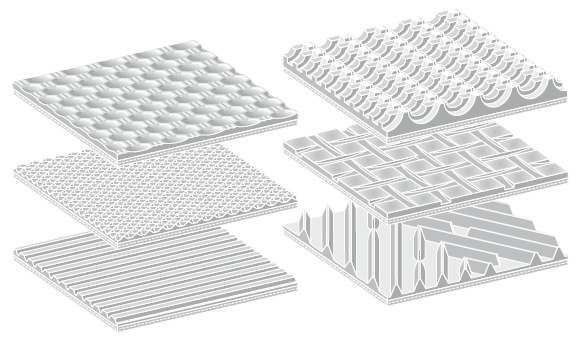
PATTERNS
Forbo Siegling has developed and optimised a wide range of surface patterns for very different applications. The appropriately optimised surface patterns ensure for example, ideal grip with demanding goods such as roller suitcases and good release properties with dough and are also used to emboss manufacturer-specific patterns on the under side of chocolate. Siegling Transilon patterned belts can run at incline angles of up to 30° without profiles. For larger incline angles they can also be fitted with profiles and sidewalls.
*For more pattern options, please contact us for details.
SPECIAL FEATURES AND PROPERTIES
Electrical properties
In numerous conveying and processing functions, the electrical properties of the belt material are important for smooth operation. As a standard, Siegling Transilon belts are equipped with a conductive tension member which prevents electrostatic build-up in the belt. Siegling Transilon non-antistatic belts (NA) are not electrically conductive. They facilitate special engineering solutions for produc tion conveyors where high frequencies are used or regulation is carried out electromagnetically e.g. in security screening and in quality control. Siegling Transilon highly conductive belts (HC) can also divert electrostatic build-up in the goods conveyed because of their highly conductive coating and/or the tension member. For the safe conveying of elec trical components and other electronically sensitive goods.
Food safety
Thanks to numerous product innovations, Forbo Siegling contributes significantly to the hygienic conditions in the sensitive production areas of the food industry. This supports you in implementing your HACCP concept. And users and end users know food has been produced safely.
-
FDA/EU: All materials used in our food types comply with the FDA 21 CFR, (EU) 10/2011 and (EC) 1935/2004 regulations on the materials used and migration thresholds.
-
Halal: In the food segment, the majority of the Siegling Transilon PU- and PVC-types are certified as complying with Halal regulations by IFRC Asia (a member of the World Halal Council).
Further special products
In addition to these patterns and features of conveyor and processing belts, Forbo Siegling offer numerous special deve lopments for various applications including:
- belts resistant to UV
- belts with silicone coatings
- flame-retardant belts
- belts for hot goods
- silent belts
- wear-resistant belts
- knife edge belts
- troughable belts
- ATEX-compliant belts
- elastic belts
SPECIAL PROCESSING
Numerous combinations of tension member-design and coating design are possible. But certain conveying and processing tasks require more: mechanical, physical or chemical belt properties which can be provided only by special production processes, combinations of materials and/or finishing.
Processing optionssuch as: Profiles/Sidewalls, Perforations, Belt edge sealing. For further information on processing, installation, and product characteristics, please contact us.
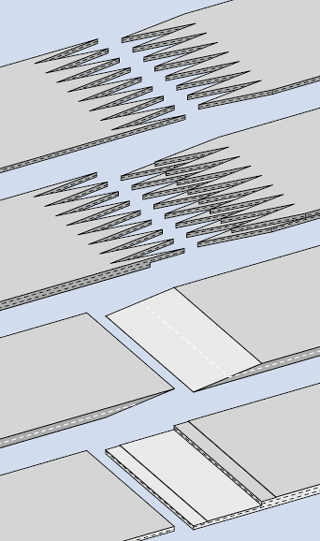
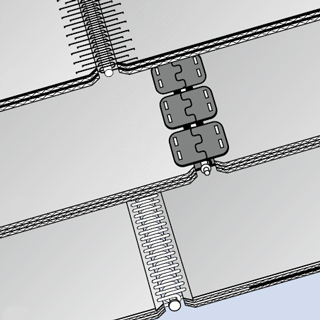
SPLICING TECHNIQUES
The splicing method appropriate for individual applications is dependent on the belt types used and the prevailing operating conditions. In addition to splice reliability, flexibility of the splice and the effort required for fabrication are decisive criteria for the selection of the splicing method. Detailed instructions for all splicing procedures are available on request.
Connection methods include hot pressing, cold pressing, mechanical fastening, etc. Please contact us for more information.